

Organizations make more sense when you see the whole system.
ABOUT WHOLEFRAME

WholeFrame was built around a simple idea: organizational performance is rarely explained by one person, one process or one problem in isolation.
Organizations are systems of people, capabilities, structures, processes, technology and working relationships that depend on one another to get work done.
When those connections work well, organizations are better able to fulfill their purpose. When they do not, the effects can appear as delays, competing priorities, repeated problems, workarounds, unclear accountability or inconsistent performance.
WholeFrame applies behavioral science and organizational systems thinking to understand why those outcomes are occurring, how the different parts of the organization connect, and where attention is most likely to make a meaningful difference.
Understand why. See how it connects. Improve what matters.
WHY WHOLEFRAME EXISTS
The visible problem is not always the real problem.
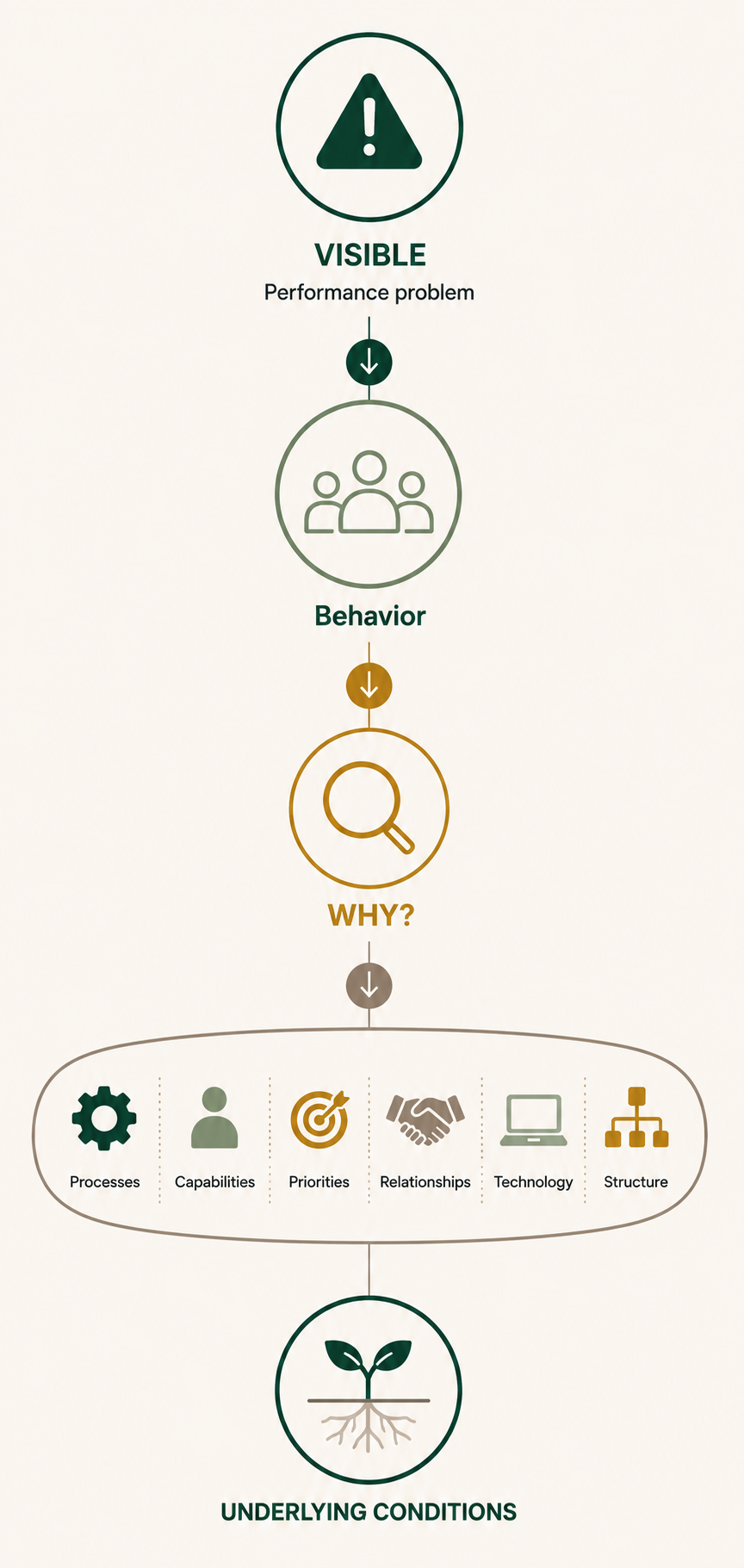
Organizations are often very good at seeing what is happening.
A process is not being followed. A department is falling behind. Employees are frustrated. A change is not producing the expected result. Performance varies. The same issue keeps returning.
What is much harder to see is why.
The conditions producing an outcome may sit somewhere entirely different from where the problem appears. A behavior may be shaped by competing priorities. A process failure may originate in a difficult handoff. A performance problem may reflect missing capability, unclear authority, technology, workload or the way several parts of the organization interact.
Looking at one part in isolation can therefore lead to solving the symptom while leaving the conditions that created it untouched.
WholeFrame was created to look beneath the visible outcome and understand the system producing it.
That means bringing together what we know about human behavior with how organizations are structured, how work actually moves, what capabilities exist, and how people, systems and technologies depend on one another.
HOW WHOLEFRAME SEES ORGANIZATIONS
An organization is more than its structure.
Organizations bring together people and systems with different capabilities to fulfill a shared purpose.
But simply having the right people, processes, technology and structures does not mean they will work effectively together. Performance emerges through the relationships and interdependencies between them — how information moves, decisions are made, responsibilities connect, capabilities are applied and work passes from one part of the organization to another.
This is why WholeFrame examines the organization as an interconnected system rather than a collection of isolated functions.

WholeFrame uses this perspective to ask a different set of questions:
What need brought the organization into existence?
What is it trying to accomplish?
What capabilities are required?
How do the different parts depend on one another?
What behaviors emerge from those conditions?
And how do those behaviors ultimately shape performance?
Understanding performance means understanding the system that produces it.
THE SCIENCE BEHIND THE APPROACH
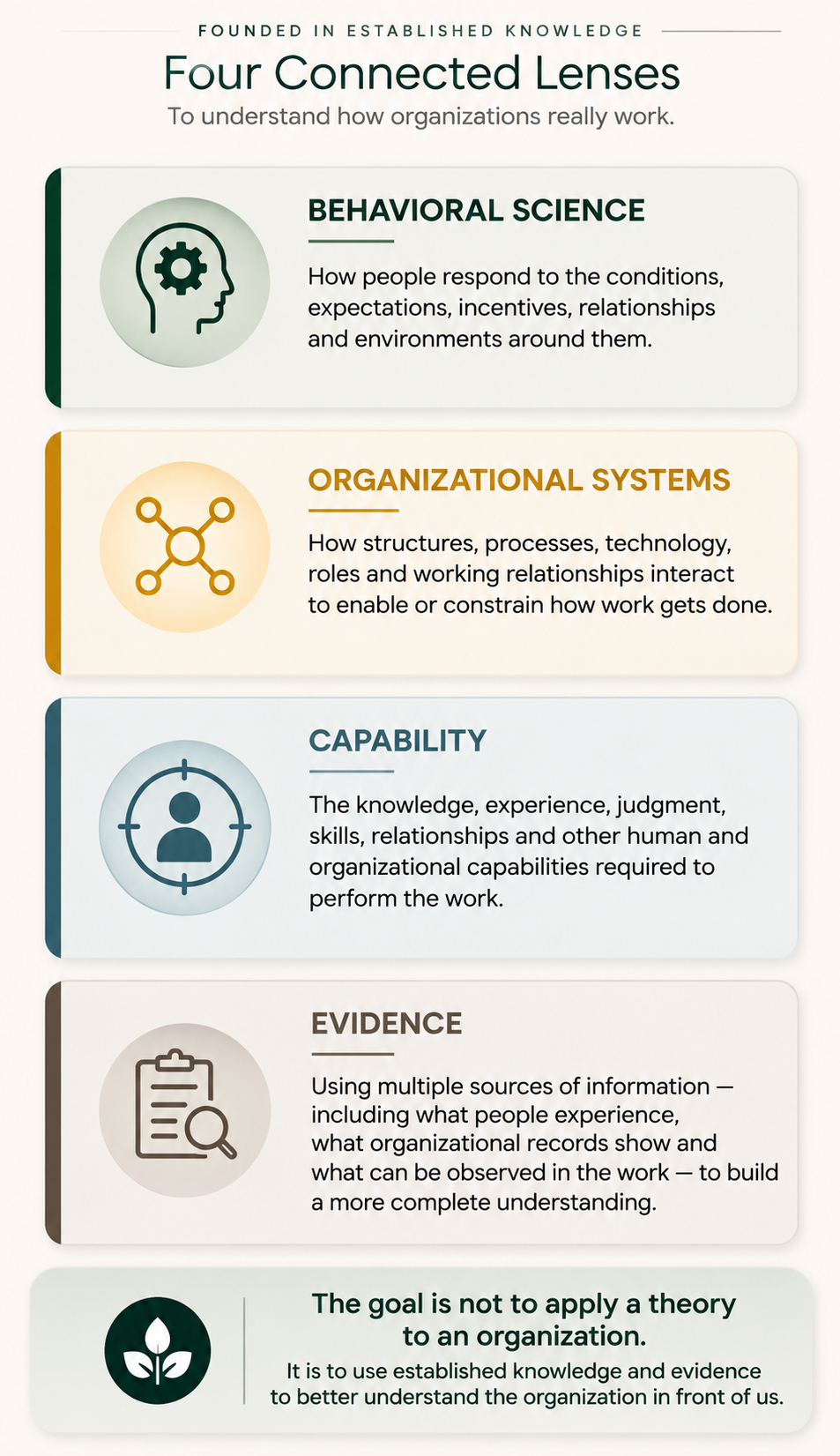
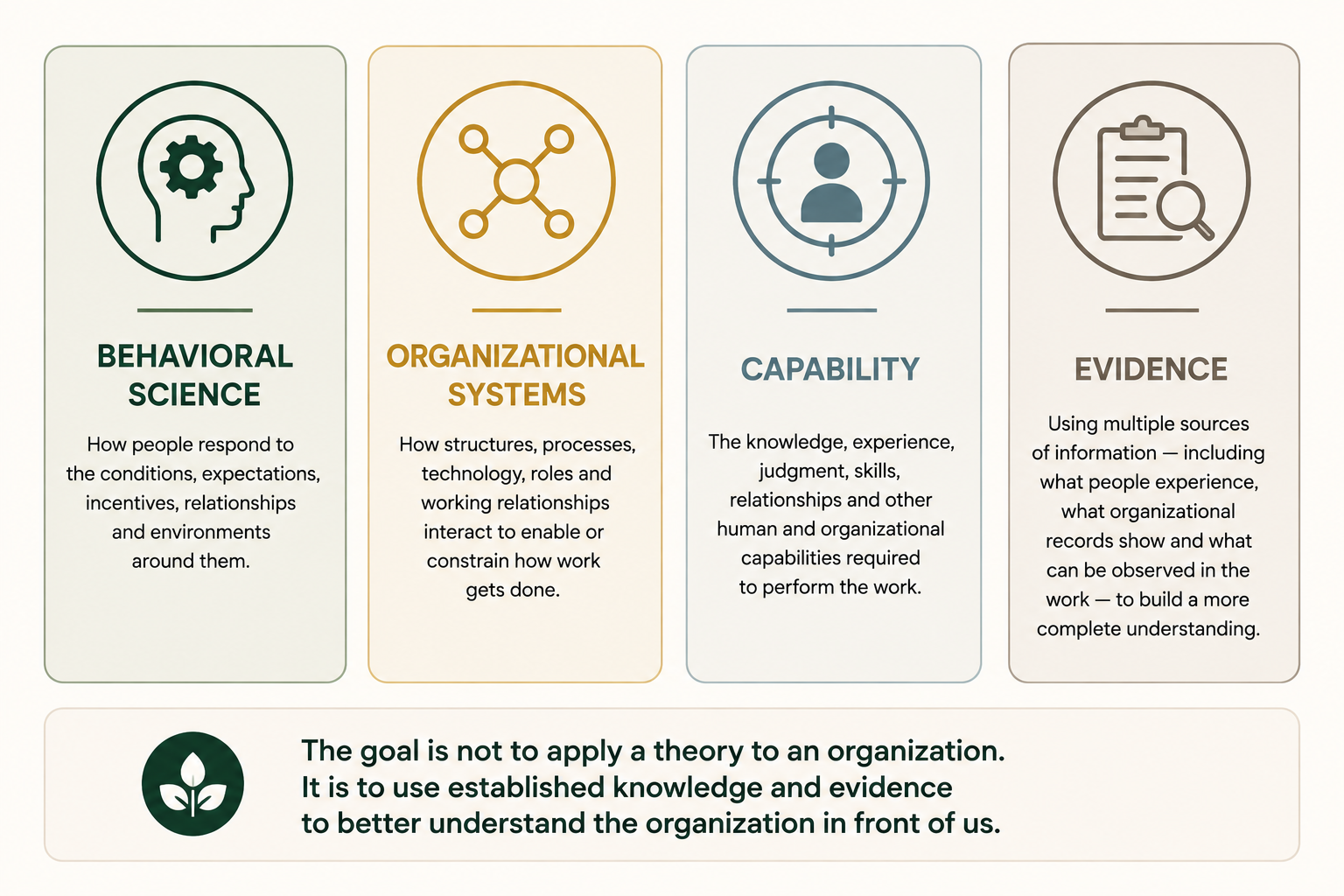
Established science. Applied to real organizational work.
WholeFrame draws from established research and practice across behavioral science, organizational behavior, systems thinking, organizational development, change management, risk and related fields.
Each provides a different way of understanding organizations. WholeFrame brings these perspectives together to examine how people behave, how work is organized, how systems interact and how organizational conditions influence performance.
FOUNDER
WholeFrame was founded by Marissa Delmage, whose career has been spent working inside complex operational organizations and trying to understand not only what was happening, but why.
Her experience spans frontline construction and safety, mining operations, corporate management systems, enterprise risk, organizational change and auditing. Across those different environments, the same pattern appeared repeatedly: organizational problems rarely belonged to only one person, one department or one process.
A safety issue could be influenced by how work was designed. A process problem could reflect unclear accountability. A change that made sense on paper could struggle because of competing priorities, capability gaps or the realities of how work actually happened.
Those experiences led to a broader question:
What if we understood organizational problems by looking at the system producing them, rather than only the symptom we could see?
WholeFrame grew from that question.
Today, Marissa brings together practical operational experience with training in occupational health and safety, enterprise risk management, change management and auditing, while continuing to build deeper expertise in organizational behavior, systems and organizational development.
The result is an approach grounded in both the realities of work and the science used to understand it.
Built from years of asking why.
The goal is simple: understand the organization well enough to improve what actually matters.
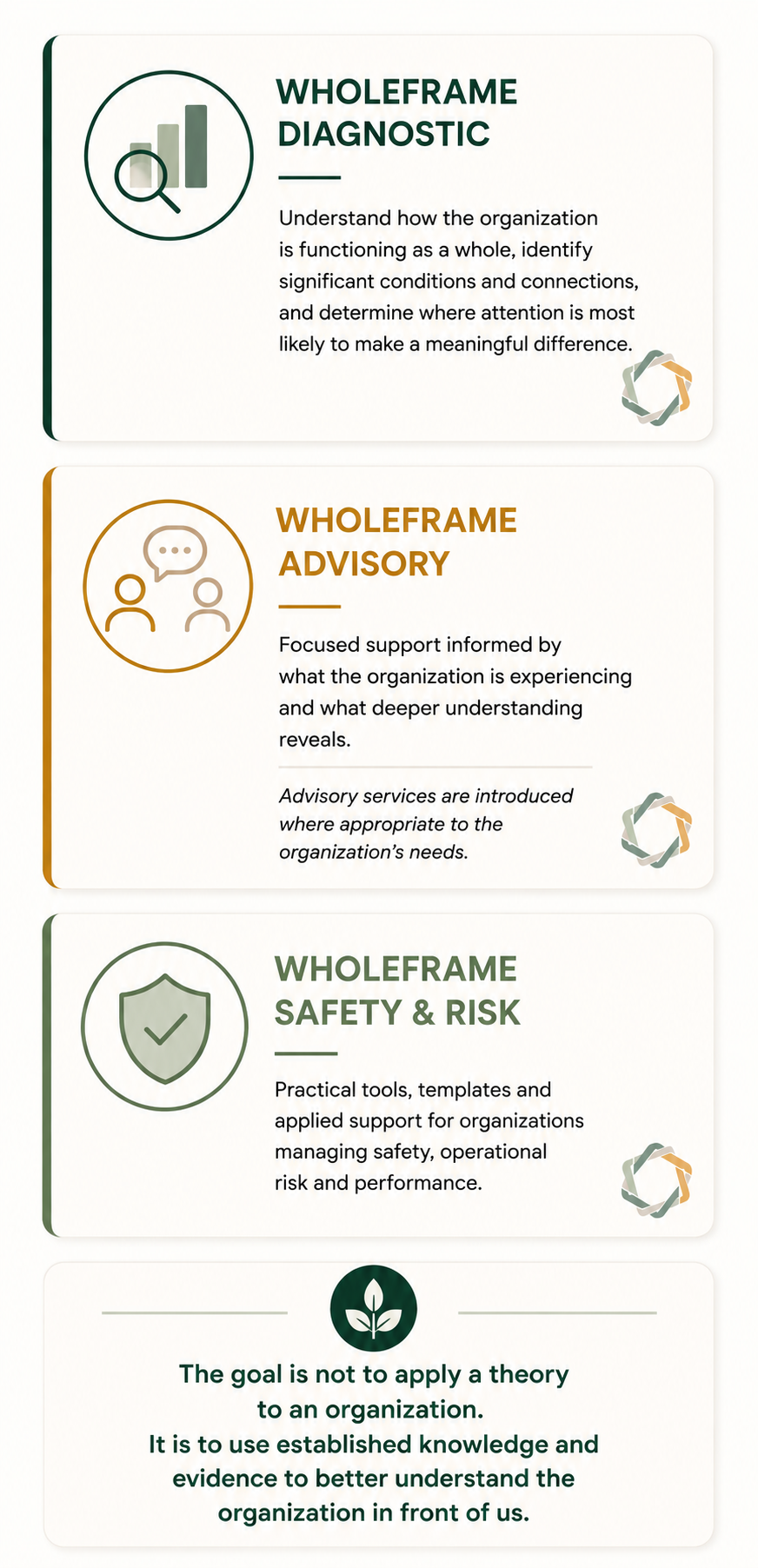
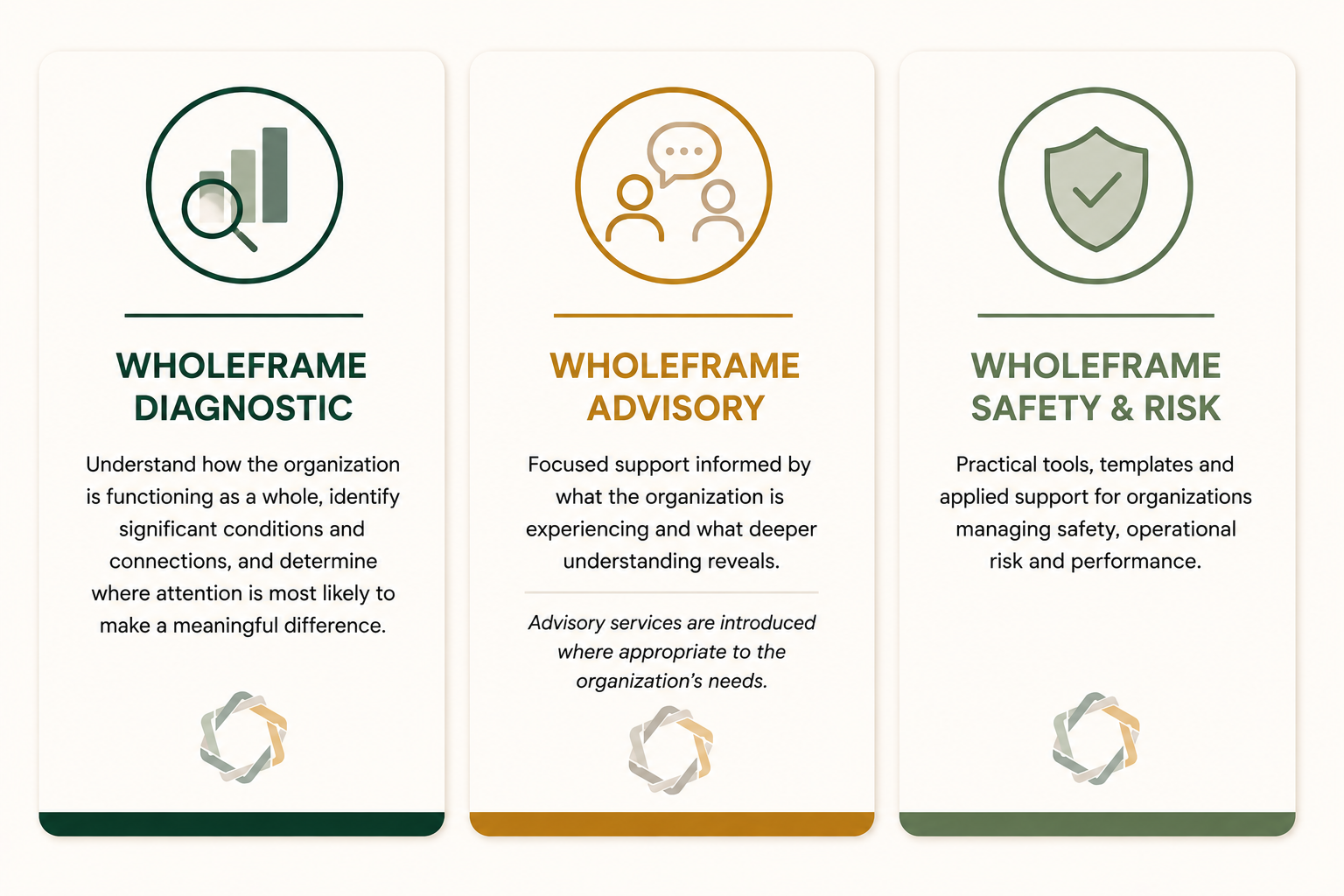
HOW WHOLEFRAME CAN HELP
Understanding is the starting point.
What comes next depends on what you need.
WholeFrame translates this perspective into practical ways to understand organizations, strengthen performance and support the work organizations need to do.
Not sure where to start?
A conversation is often the simplest first step.
Begin a Data-Driven Partnership
Submit the inquiry form to discuss tailored strategies that deliver immediate efficiencies and sustained competitive advantage.